
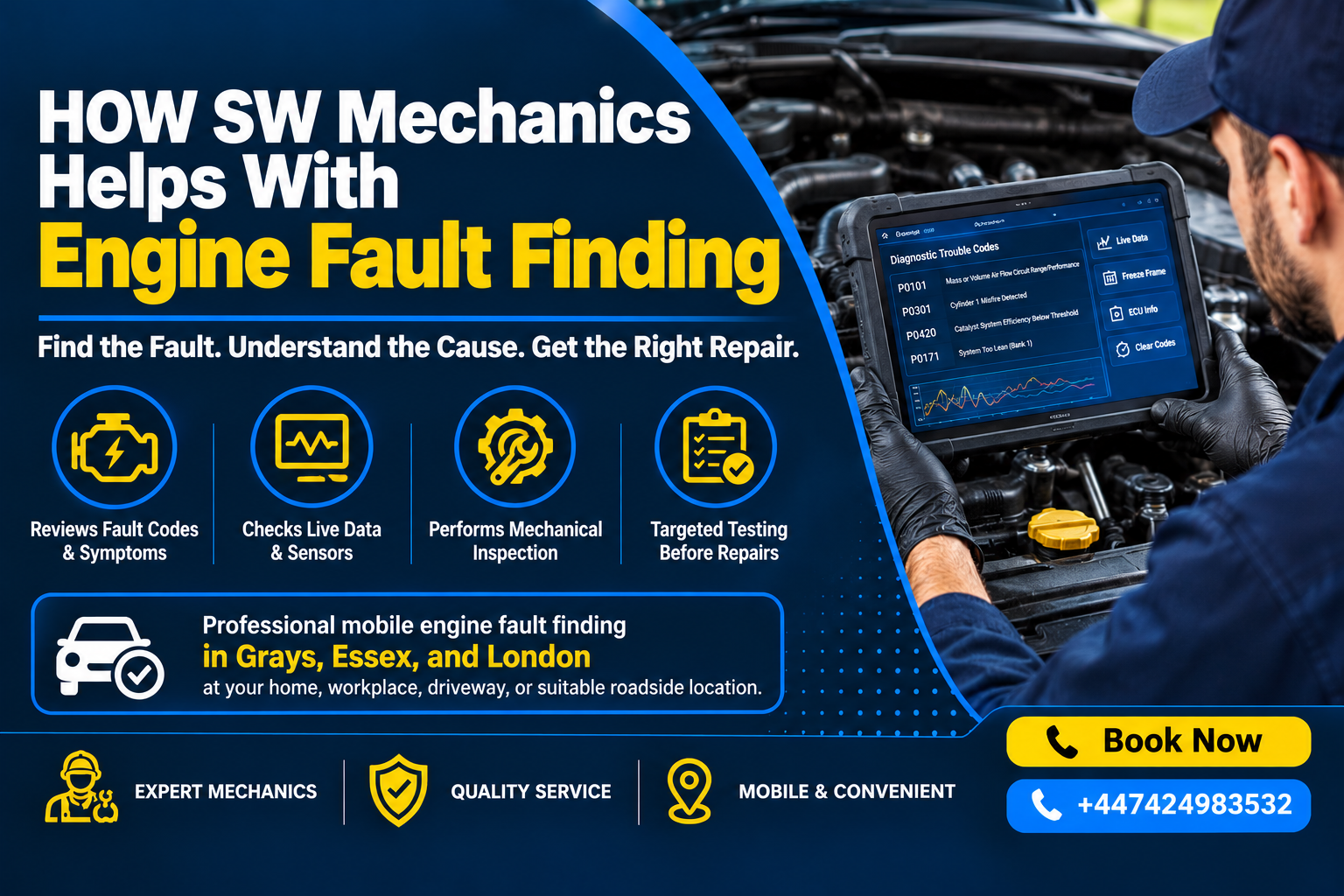
Engine problems can appear in many ways. You may notice a warning light, rough running, unusual noises, poor starting, reduced power, or higher fuel use.
SW Mechanics provides mobile engine fault finding to help identify
the cause of these problems. We combine diagnostic equipment with practical
mechanical checks to find the likely fault and recommend the right repair.
Finding a problem early can help prevent further damage and avoid
unnecessary repair costs.
What Is Engine Fault Finding?
Engine fault finding is the process of identifying why an engine is not working as it should.
The fault may involve the ignition system, fuel system, air intake,
sensors, wiring, cooling system, emissions equipment, or internal engine
components.
A warning light or symptom is only the starting point. Proper testing is
needed to confirm the cause.
SW Mechanics combines diagnostic equipment with mechanical inspection. We
can check stored fault codes, review live data, inspect accessible components,
listen for unusual noises, and test related systems.
Common Signs of an Engine Fault
You may need an engine fault finding inspection if you notice:
- A check-engine or
engine-management warning light
- Rough idling, hesitation, or
misfiring
- Hard starting or repeated
stalling
- Loss of power or slow
acceleration
- Tapping, knocking, rattling, or
whining noises
- Poor fuel economy
- Excessive smoke or unusual
exhaust smells
- Engine overheating
- Limp mode or restricted
performance
- A fault that appears after a
battery change or repair
A flashing warning light, severe power loss, smoke, overheating, or an
unsafe driving condition should be treated as urgent. Stop driving when safe
and arrange professional assistance.
How SW Mechanics Finds the Fault
1. Review the Symptoms and Vehicle
History
We first discuss what you have noticed, when the problem started, and
whether it happens all the time or only under certain conditions.
We also check whether a recent repair, service, battery replacement, or
warning light occurred before the fault appeared.
2. Carry Out a Visual and Mechanical
Inspection
Accessible hoses, wiring, connectors, belts, fluids, air-intake parts,
exhaust components, and engine-bay areas are checked for:
- Damage
- Leaks
- Loose connections
- Contamination
- Signs of previous repairs
3. Perform a Diagnostic Scan
We use suitable diagnostic equipment to communicate with the vehicle's
control modules.
This can provide stored, pending, and manufacturer-specific fault
information that may not be available through a basic code reader.
4. Analyse Live Data
A fault code does not automatically mean that a particular part has
failed.
We can compare available readings such as:
- Engine speed
- Temperatures
- Fuel trims
- Airflow
- Pressures
- Sensor values
This helps determine whether the related system is operating correctly.
5. Carry Out Targeted Testing
When required, we test wiring, sensors, ignition components, fuel
delivery, air leaks, charging systems, cooling components, and related
circuits.
Mechanical symptoms may require additional checks to determine whether
the problem is electronic or mechanical.
6. Explain the Repair Recommendation
After testing, we explain the likely cause and the evidence behind the
finding.
We also explain how urgent the problem is and what repair may be
required. This gives you practical information instead of replacing parts based
only on a fault code.
Why a Fault Code Is Not the Whole
Diagnosis
A diagnostic code usually identifies a system, circuit, or condition. It
does not always prove that a specific component has failed.
For example, a sensor-related code could be caused by:
- Damaged wiring
- An intake leak
- Low voltage
- Contamination
- Another fault affecting the
system
Replacing parts without testing can waste money and leave the original
problem unresolved.
SW Mechanics uses fault codes as a starting point. We then use live data,
inspection, and targeted testing to help confirm the actual cause.
Mobile Engine Fault Finding at Home or
Work
A vehicle with an engine problem may be difficult or unsafe to drive to a
garage.
SW Mechanics can provide mobile engine fault finding at your home,
workplace, driveway, or a suitable roadside location when it is safe to inspect
the vehicle.
Mobile service can be useful when:
- The engine will not start
- A warning light has appeared
- The vehicle has entered limp mode
- The engine is running poorly
- You want an assessment before
arranging recovery
If the fault requires workshop equipment or the location is unsafe, we
can explain the safest next step.
Engine Fault Finding for Cars, Vans,
and Trucks
Cars, vans, SUVs, trucks, and commercial vehicles can use different
engine-management systems and diagnostic procedures.
The correct equipment, software coverage, and testing process depend on
the vehicle and the fault.
SW Mechanics can help investigate:
- Starting problems
- Warning lights
- Loss of power
- Poor fuel economy
- Emissions faults
- Unusual engine noises
- Rough running
- Engine-management problems
Why Early Fault Detection Matters
Ignoring an engine fault can allow a small problem to affect other
components.
For example, a misfire may damage the catalytic converter. A
cooling-system fault can cause overheating. Fuel or air problems can increase
emissions and reduce fuel economy.
Unusual mechanical noises can also become more serious if the underlying
problem is not checked.
Early engine fault diagnosis gives you a clearer understanding of
the problem before you authorise repairs. It can also help you plan the
required work and reduce the risk of further damage.
Why Choose SW Mechanics?
SW Mechanics combines mobile convenience with diagnostic testing and
mechanical inspection.
We do not simply clear a warning light or replace parts based on
guesswork. We investigate the problem, explain the findings, and recommend the
next step based on the condition of the vehicle.
Our service can help if you are looking for:
- A professional mobile mechanic
- A diagnostic mechanic
- Mobile vehicle repair
- Mobile car diagnostics
- A mechanic that comes to you
- Mobile engine fault finding
Accurate testing should come before unnecessary parts replacement.
Book Mobile Engine Fault Finding With
SW Mechanics
Do not ignore poor starting, unusual engine noises, warning lights, loss
of power, rough running, or changing fuel economy.
Contact SW Mechanics to arrange mobile engine fault finding at a
convenient location.
We will review the symptoms, carry out appropriate diagnostic and
mechanical checks, identify the likely fault, and explain the recommended
repair.
Frequently Asked Questions
What Is the Difference Between Engine
Fault Finding and a Diagnostic Scan?
A diagnostic scan reads electronic information from the vehicle.
Engine fault finding goes further by combining fault codes with symptoms,
live data, visual inspection, and targeted testing to help confirm the cause.
Can a Mobile Mechanic Find an Engine
Fault at Home?
In many cases, yes. Mobile fault finding can be performed at home, work,
in a driveway, or at a suitable roadside location when the vehicle and
surroundings are safe.
Can Fault Finding Identify Unusual
Engine Noises?
It can help investigate unusual noises by combining symptom analysis,
listening, visual inspection, diagnostic data, and mechanical checks.
Some internal engine faults may require additional workshop testing for
full confirmation.
Should I Drive With an Engine Warning
Light On?
A steady warning light should be checked promptly.
A flashing warning light, severe running problem, overheating, smoke, or
major power loss may indicate an urgent fault. Stop driving when safe and
arrange professional assistance.
Will Clearing the Warning Light Fix
the Engine Fault?
No. Clearing a code only removes the stored warning. If the underlying
fault remains, the code and warning light may return.
Can Engine Fault Finding Improve Fuel
Economy?
Finding and repairing faults involving sensors, fuel mixture, ignition,
air intake, or engine management may help restore fuel economy when those
faults are causing excessive fuel use.
Can You Diagnose Vans and Trucks?
Many cars, vans, trucks, and commercial vehicles can be inspected.
However, the required equipment depends on the vehicle, system, and fault.
Can I Get a Repair Quote After Fault
Finding?
Yes. Once the likely cause and required work are understood, SW Mechanics can explain the recommended repair and provide a quote when the repair scope is clear.